Roy flew to Pittsburgh on the last flight Friday night with his bag that still had the Boston laundry in it.
He got the case at six that evening in Meyer’s office. Meyer called it a detail, not a reassignment, and said the forged firmware was federal and Roy was the one who’d been saying so since last week, so Roy could go be right in Pennsylvania. Roy understood the shape of it. The case could not be solved in time to help the person it was about, and somebody had decided it should belong to the agent who had already annoyed everyone about it. He took it anyway. It was the first thing since Meyer took over that was his to work on.
The hospital was a tired brick building off a parkway with a helipad on the roof and a loading dock in back. He parked in a visitor spot and went in the front and showed his badge to a volunteer at a desk who did not know what an FBI badge was supposed to do and called someone.
Inside, the place was running on paper. There were whiteboards in the hallways with patient names and numbers written in marker, runners carrying folders, and a nurse in a doorway holding a bag of fluid up to the light and counting against her watch with her lips moving. Roy had seen a bank run on paper on Saturday in Greeley and it had looked almost exactly like this, people doing by hand the thing a machine was supposed to do, except in Greeley nobody died if someone counted wrong.
The chief nursing officer met him on the second floor. Her name was Kostelnik and she had an orange vest folded over her arm that she did not put on. She took him to the boardroom where they ran the incident and told him what she could, which was that overnight the infusion pumps had installed an update nobody had sent, that one patient on a cardiac floor had been hurt and was stable, that they were counting everything by hand now, even though all the devices said they were fine.
“They say they’re fine,” Roy said.
“Every one of them. Up to date. Green.” She looked tired. “The screens are the problem. The screens say the right number. But it’s not the number the machine is using.”
Roy wrote screens say right number — not true in his notebook, in blue.
He asked her who had caught it. She said the charge nurse on 4 West caught the patient, and the biomed technician in the basement had been saying the pumps were wrong for the last two weeks, in writing, to anybody who would listen.
“In writing,” Roy said.
“She keeps a book.”
He asked to see the book and the technician.
The shop was in the basement by the loading dock, forty square feet of bench with a rack of infusion pumps on it, each one with a screen glowing and, Roy now understood, each one lying. A woman in her fifties was at the bench with reading glasses pushed up into gray hair and another pair on a beaded cord around her neck. Her name was Evans. She had cargo pants with tools in them and the hands of somebody who worked with them.
She did not seem glad to see him and she did not seem afraid of him either, which Roy liked.
“You’re the FBI,” she said.
“Supervisory Special Agent Pittman. Denver.”
“Denver.”
“It’s a long story.”
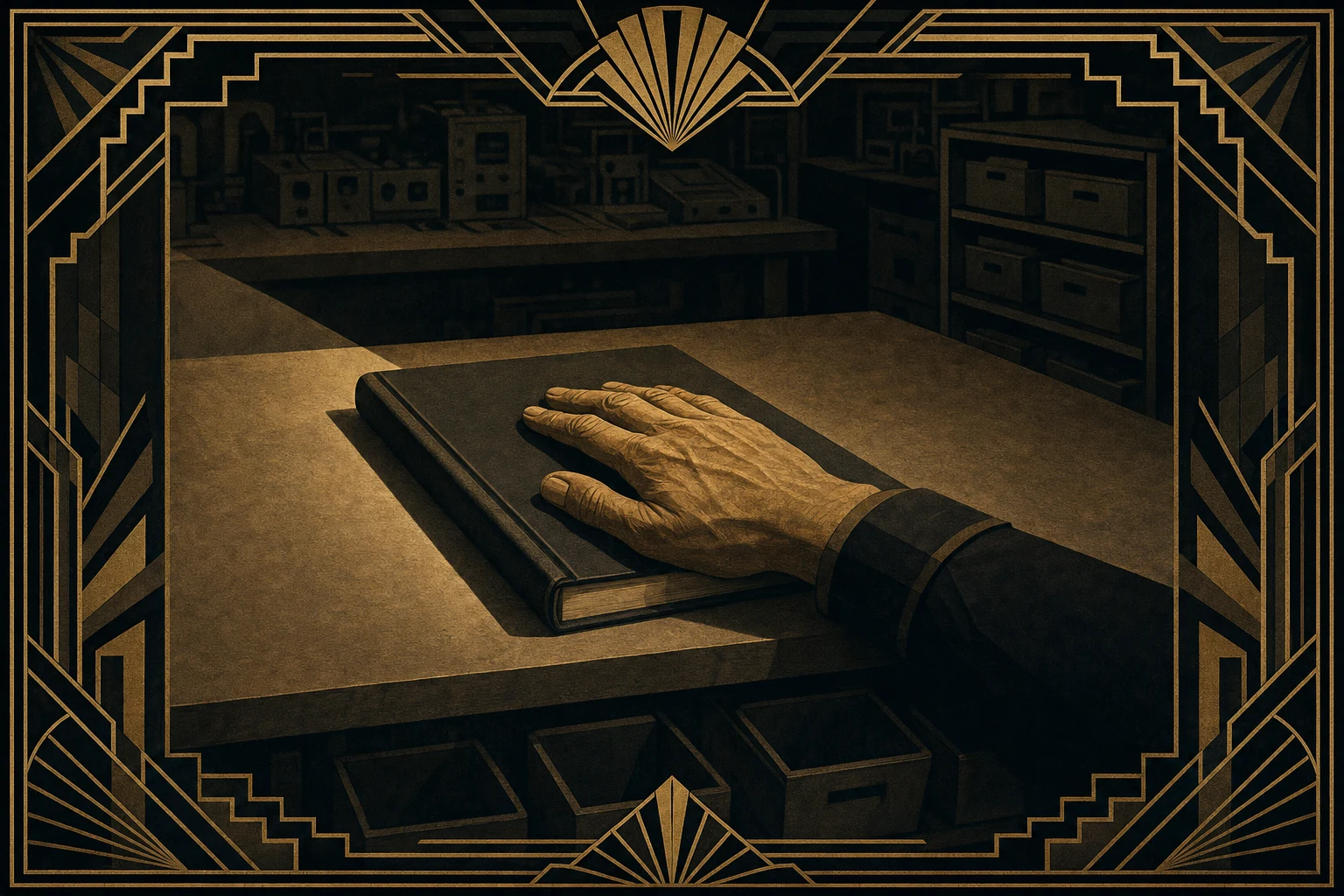
She took a hardbound notebook down off a shelf over the parts bins, third from the left, and set it on the bench and opened it to a page without looking for it. The spine had the year on a strip of tape and under it, in smaller letters, a 2.
“It started two weeks ago,” she said, and turned back through the pages while he watched. Every page was dated. Every entry had an asset number and a model and a line of what she had done and what the machine had done back. He read the one from two weeks ago. Update fails at ~90 sec. UPDATE PACKAGE NOT VERIFIED. He read the one from yesterday. All 340s in shop show UPDATE COMPLETE 0251. Not a Corbin build. I did not push it.
Roy had spent nineteen years learning to tell a record that was made as things happened from a record made afterward to cover somebody. This was a very good version of the first kind.
“The computer up there says these took an update in the night,” she said. “The book says they’ve been broken for two weeks and I never sent them anything. Both of those can’t be true. The book’s right.”
“I know it is,” Roy said.
He meant it. Upstairs every machine in the building and every record the machines kept would tell him the pumps were current and healthy, signed and correct, because the thing that had happened was that somebody had taught the machines to say so. The only account of the last two weeks in the whole building that could not be rewritten was a quad-ruled notebook this woman kept.
He asked if he could take it. She didn’t like that.
“I need it,” she said. “I’m working off it. It’s the only thing in this hospital that is correct.”
“I’ll photograph every page and give it back today,” Roy said. “I’ll sign for it. You’ll have it back on this bench before you go home.”
She thought about it and said okay. He wrote her a receipt on a page of his own notebook, torn out, with the date and the asset count and her name and his, and the time, and held it out to her. She read every word of it before she took it, which he liked.
He went back up to the boardroom and worked until the middle of the afternoon. He talked to the charge nurse, whose name was on the whiteboard as the one who had caught the patient, and she told him about the bag that was almost empty at change of shift and the screen that said eighteen, and he wrote it down the way she said it. He got the patient’s outcome from Kostelnik and wrote that down too and did not write more than the line it needed. He had the thing he had come for, which was an account of what had happened that would survive being questioned.
At the boardroom table he stopped once and thought about Tuesday.
On Tuesday he had signed a thin bearded kid out of a federal building and driven him to Boulder, breaking about four rules to do it, because a woman named Voss said the kid was the only person alive who could fix the thing that was coming. The kid had fixed it. An attack had come anyway, smaller, from a direction no one was watching. For the two weeks before Tuesday Roy had been certain the kid and his two friends were the threat. They had been the ones trying to stop it.
He didn’t write that in the notebook. It wasn’t evidence. He wrote firmware forged off public disclosure — not the Hale group — opportunistic.
At four he took the book back down to the basement. Evans was on the phone, on hold, the same hold music he could hear across the bench, and she lifted her chin at him and he set the notebook on the shelf, third from the left, where it went. She put her hand flat on it for a second without stopping her call.
Roy went out the back, past the loading dock, and sat in the rental car in the hospital lot with his own notebook open on the wheel. He had a case now, a real one. He started writing it up while it was fresh with the smell from his bag of clothes filling the car.