Sable arrived at the Institute for Applied Optics at 11:20 UTC after nine hours in a car and one on foot through three doors that each needed a different security card. Ochre was waiting with two cups of tea.
“You came to look at it,” Ochre said.
“Yes. Now.”
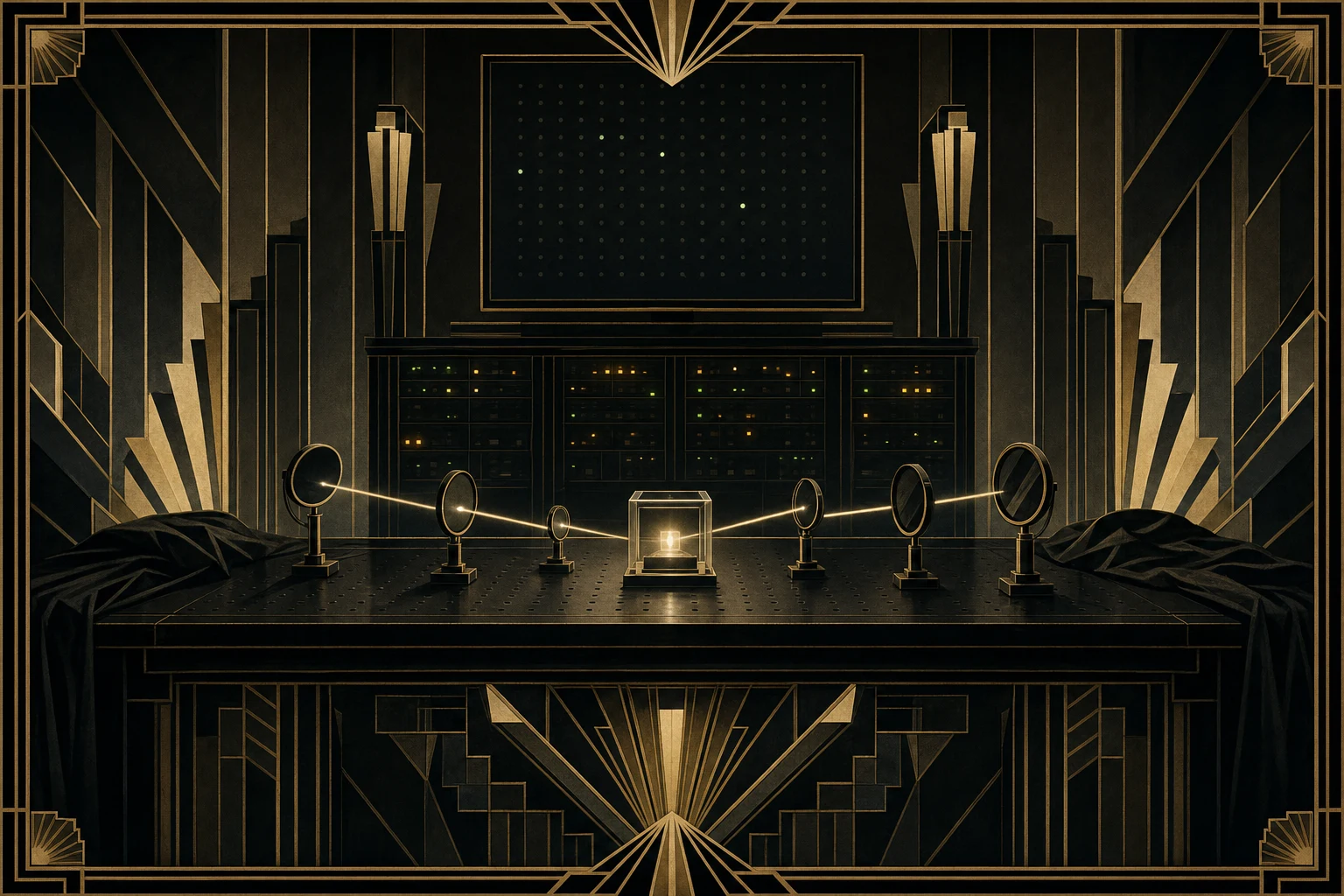
The room was dim and cold. Sable had expected something larger. There were two long tables that were somehow suspended, not anchored, covered with mirrors and lenses and metal posts and black cloth. In the middle sat a small glass cell no bigger than a can of soup. The racks along the wall hummed and blinked. Two physicists in fleeces sat in front of four monitors, staring intently, ignoring Sable and Ochre.
“That is all of it,” Ochre said.
“Show me what it sees.”
One of the physicists put an image on the large monitor on the wall. It was a grid of dots, some lit and some dark, very even. A second later it changed. Then it changed again.
“Eleven thousand atoms,” Ochre said. “Perhaps six hundred of them are doing the calculation. The rest are there to catch the mistakes of the six hundred.”
“That is a poor ratio.”
“It is the ratio our machine has to live with. Hale’s is better.”
Sable watched the grid change for a while. Sable had been told for a year that this machine was the most important object in the country. It looked like a camera pointed at a colander.
“The practice numbers,” Sable said.
“We finished the last one at four this morning. We gave it a number we already knew the answer to, as with the others.” Ochre drank some tea. “It came back right nine times in ten.”
“And the tenth time?”
“The tenth time it came back with a very confident wrong answer. We are working on figuring out why.”
“Show me the wrong one.”
Ochre said something to the physicists. The image on the monitor on the wall changed. Now it was a number, sixty digits long, scaled up and wrapped so all of it showed clearly.
“It is a beautiful number,” Ochre said. “It is not a factor of anything.”
Carmine came in without knocking. He had a leather folder under one arm and a phone in the other hand that was playing a news report. He held the phone up so Sable could see the school photograph of Hale.
“Hundreds of policemen,” Carmine said, “and this is what they have.”
“They also have the man laughing.”
“Yes. So very not helpful.” Carmine put the phone away. He was pleased with himself about how useless the Americans were, as though he had arranged their incompetence personally.
Sable knew Carmine had been promoted twice in two years for things that had not yet happened.
“The minister wants to know when,” said Carmine.
“When what.”
“When the machine begins the real number.”
Ochre looked at Sable and said nothing.
“If we begin today,” Sable said, “the machine does nothing else until it is finished. It works on one number.”
“Then it works on one number,” said Carmine. “That is the number we built it for.”
Sable was annoyed. Carmine was an ass-kissing bureaucrat. “We built it for that number because we could not build it for anything better. There are three people in Colorado who can do better. If one of them is in this room next week, I would like the machine to be available.”
“If one of them is in this room next week,” Carmine said, “it will be the greatest achievement in the history of our service, and I will personally apologize to you.” He opened the folder. “Until then, the minister has a list.”
He handed Sable a single page.
It was a list for a parade. Three electric companies, the control system of a port, a satellite operator, the payment network of a country that bordered theirs, and the water authority of a city Sable had to think about before remembering where it was. Each had a date beside it. The first date was nine days out.
“Everything on this page will have a new root inside a month,” Sable said. “I read their purchase orders in the car. The Americans are already buying the parts. They are hiring people to go and change them by hand. By the time the minister reaches the fourth line, the key will not open any of these.”
“Then what will it open?”
“Everything nobody can reach with a screwdriver. Controllers in buildings. Pumps. Medical equipment. Anything with the old root in it and no way to update it unless a person is standing in front of it.” Sable handed the page back. “After the rotation, that is most of what the key will open.”
Carmine looked at the page as if it had changed while Sable was holding it.
“The minister is not interested in hospitals.”
“I did not say the minister was.”
The lights went down, dropping to half. The hum from the racks changed and both physicists put their hands flat on the desk in front of them as if they could hold the building still. On the large monitor the grid of dots went gray and then black.
Nobody spoke. After four seconds the lights came back up. Somewhere below them a diesel engine was running.
The grid came back one dot at a time.
“How often does that happen,” Sable said.
“Twice a week,” one of the physicists said without turning around. “Sometimes three times. We have the generator.”
“And if it happens during the real number?”
“Then we lose the atoms and start that part again,” Ochre said. “Not the whole run. Catching back up takes an hour. Or maybe two. It depends where it is.”
Sable did the sum. Twice a week, up to two hours each time, on a run that would take about two weeks. It was stupid. The Americans had a pathetic power grid and still did not lose power to a building twice a week.
“One more day,” Sable said to Carmine. “I will tell you tomorrow.”
“The minister —”
“The minister has waited a year. The minister can wait until tomorrow.”
Carmine closed the folder and left, and did not close the door.
“He will call someone,” Ochre said.
“He calls someone every day. It is the only thing he does quickly.”
Sable had not eaten since the car. There was a small kitchen at the end of the corridor with a table, four chairs, and a kettle. The kettle had a piece of tape across the switch and a note in careful handwriting.
DO NOT USE. Trips the breaker for Lab 2. — K.
Sable’s phone buzzed. It was a message from the ministry, from a number Sable did not have saved in their phone.
The minister will call you tomorrow at 08:00 UTC.
Sable put the phone away and went back and asked Ochre for the other cup of tea.