DAY 1
The array had been wrong eleven thousand times tonight.
Samantha watched the number on the left monitor refuse to settle. One run of Persephone meant nothing — she’d quit watching single runs months ago.
The algorithm didn’t need any of the runs to be right. Persephone needed ten thousand wrong ones, all wrong the same way, while someone sat in the dark and waited for the answer to climb out of the noise.
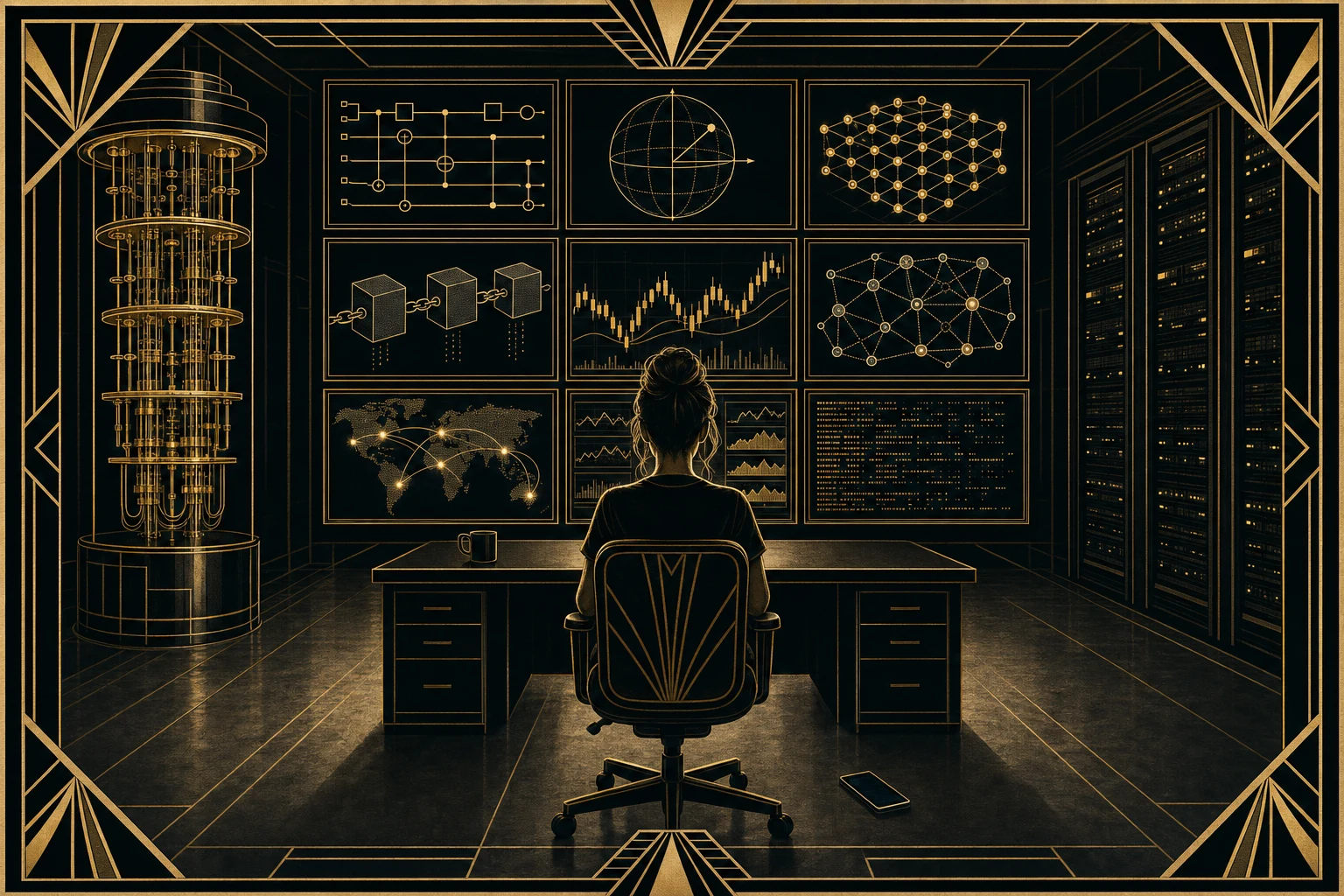
Marcus had left at nine — a wave and something about a call in the Bay Area. Vlad had left the way Vlad left; she’d looked up at some point and he was gone. Now it was just her and the machine: a few hundred atoms held in laser light, colder than deep space.
She had spent the last two years of her life working on an algorithm to get the atoms to be still. She’d stopped calling people back somewhere in there, and eventually they’d stopped calling. She was thinking about packing it in for the night and going for a run, something she did often after she was done working but her brain wouldn’t shut off.
Out her door she could be on the Rio Grande Trail in a few minutes, or up one of the mountain trails above Basalt with the town asleep below her. Sometimes she drove up the Frying Pan Road toward Ruedi and ran on the Ruedi Overlook Trail until it got light. She processed stuff this way and got tired enough to get some sleep.
The settings that she used weren’t in a file anymore — there were too many, all drifting, and always pulling on each other. She’d stopped writing them down a while ago and memorized the key ones instead. You could burn the building down and destroy all the hardware. It wouldn’t matter — you could buy more. The important stuff was now in her head. And she didn’t trust it being anywhere else.
She’d picked the current target weeks ago, for one boring reason: it was easy to check.
It was an old address. Pay-to-public-key, from back before anyone thought to hide a key behind a hash. The public key sat right out on the chain, naked, and untouched for twenty years. If Persephone worked, it would take that public key and hand her back the private one. Then she wouldn’t have to trust herself anymore since she had Persephone. Run the private key forward, regenerate the public one, compare. The chain didn’t care how many times she tried. It would say yes or no.
The noise on the screen took a shape. The shape sharpened. Resolved.
A number.
She copied it into the one-line check she’d written for exactly this — private key in, public key out. Ran it. The two strings stacked on her screen, on top of each other.
They matched.
A chill ran up her spine. She closed her eyes. She sat there for a few seconds, breathing slowly in and out.
She opened her eyes and looked again. She read the strings character by character on both rows. The private key to an address nobody had touched since she was in elementary school was sitting on her screen, pulled out of nothing but the public number that had sat on the chain in plain view, waiting for math that wasn’t supposed to exist.
She’d realized she’d been holding her breath. She let it out slowly.
The lab was dead quiet other than the hum of the machine. She was the only person alive who knew, and there was no one alive she wanted to share it with. Her phone sat face-down on the desk where it had been all night. She was afraid to touch it.
Holy shit. It worked. Not in simulation. Not on some toy modulus she’d shrunk down until the machine could handle it. On a real key. On the actual curve. And the same math killed everything else — every bank login, every silly crypto thing, and every signed firmware update.
Her fear was old by now — she’d scared herself that this could happen so many times she was dull to it. Underneath her fear sat the idea that let her sleep: that the lattices held. The new math the world had spent a decade crawling toward had no handle for Persephone to grab. But what if it did?
It was three in the morning. She’d been awake for twenty hours and had just watched her own code tell her the one thing she most wanted to hear, but was also terrified of. She’d planned for exactly this.
She needed to validate this for real. She typed the startup sequence for Marcus’s software harness.
He’d built it months back, a rig to check key recovery against live targets, from back when “live targets” meant the throwaway addresses they set up to practice on. It ran independent of her code, so the algorithm was working with a clean setup.
She loaded the recovered key, pointed the harness at the address, hit enter — already half standing, grabbing her phone, now ready to call Marcus, so she could tell him she’d figured it out.
The harness printed a status line.
target: live · mode: confirm-by-spend
She dropped the phone on the ground.
That wasn’t an offline check. That wasn’t regenerate-and-compare. Confirm by spend meant the harness was going to prove control of the address the one way that couldn’t be faked — by doing the single thing only the holder of the private key could do. By moving the coins.
constructing transaction…
signing…
broadcasting to peers…
“No-ooooooooo.” She said it to the empty lab and frantically pounded on Ctrl-C.
You couldn’t call back a transaction once it was in the mempool. She knew that as well as anyone. The coins that hadn’t moved in twenty years were moving. And in a few seconds, on a network that never slept and never forgot and was watched by every government and every fortune and every insomniac on Earth, every last node was going to see it happen.