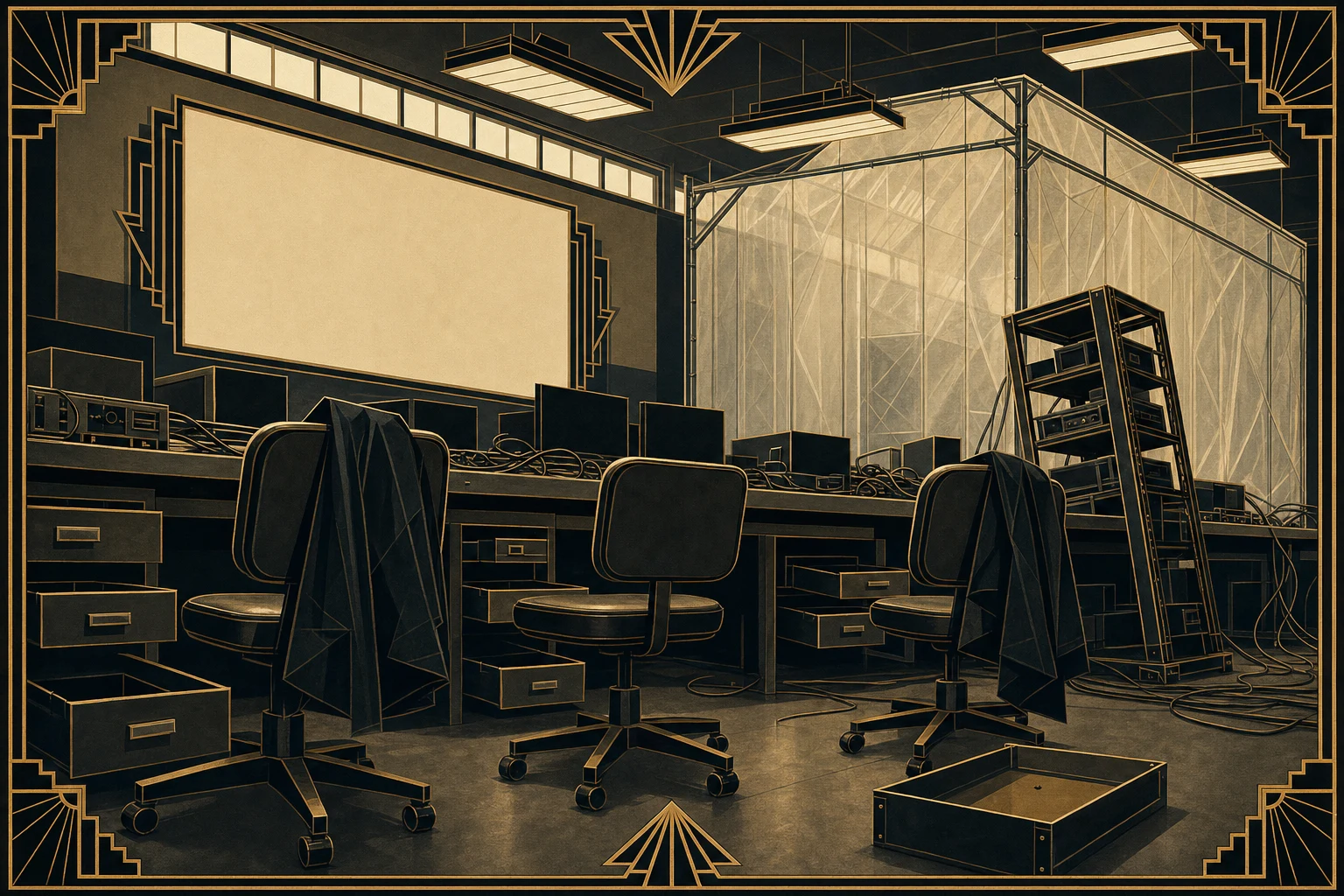
Every light was on in the lab.
Roy stood inside the door with his hands in his coat pockets, systematically looking at everything he could see. Evidence Response had been here twice yesterday and they had done it fast, which is what he had asked for, and it showed. Drawers were open. There was a torn glove on the floor by the fume hood. A rack of equipment had been pulled away from the wall.
He read their inventory on the drive over — sixty-one items, four pages, a photograph of each one. None of it told him where they had gone.
The main room was a long open bay with a concrete floor and a steel structure in the middle of it the size of a pool table. It was under a plastic tent with over a hundred cables going into it. A mountain was visible from the windows along the top of the north wall. The building was off Two Rivers Road with BASALT LABS on the door on a piece of white vinyl.
The briefing said the machine used lasers to hold single atoms in a grid and do math that ordinary computers could not do. Roy knew what the individual words meant, but didn’t really understand the implication of the briefing.
The bench ran twenty feet along the west wall, under a whiteboard, with three chairs at it.
Not a conference table. A work bench, with three task chairs pushed up to it. Each chair had a track worn into the mat underneath it. Three sets of two monitors. A handful of pens scattered around with a cup holding three more. Two of the chairs had a jacket over the back.
He walked the length of the bench and looked at the mats and then went back to the door and looked at the room from there.
Then he called Denver.
Odom picked up on the second ring. She was the forensic accountant on his squad and she was better at this than he was. He didn’t dare tell her that because of how insufferable she could be.
“How many people worked here.”
“Payroll says eleven. Nine are accounted for.”
“Reed and Hale are the ones missing?”
“Yes.”
“There are three chairs at the bench.”
He heard her stop typing. “So?”
“There’s a bench with three chairs at it with three worn spots.”
He looked up at the whiteboard. There was a bizarre diagram on it and a phone number scribbled in the bottom right corner with the word “plumber” after it.
“The Delaware filing has three principals,” Odom said.
“Somebody was in here every day who isn’t on your payroll.”
“The certificate of incorporation names three. Reed, Hale, and a third. The third one has no salary, no equity vesting schedule, no K-1, no bank signature card, and no social. The name resolves to nothing.”
Roy put his hand on the back of the third chair.
“Nominee,” he said.
“That would be my read. It’s a Delaware filing. It’s what the service companies do.”
“Task it anyway. Subpoena the registered agent, get the engagement letter, find out who paid the filing fee.”
“It’s already in. Two-week turnaround.”
“Push it.”
“Roy. Everything is pushed.”
He looked at the chair a moment longer, then let go of it and wrote 3rd chair — nominee? in his notebook and drew a line under it.
Somebody knocked on the frame of the open door.
She was in her sixties, in a vest with a fly shop’s name on it, holding a foil pan with a lid on it. She said her name was Deb Rickert, had the unit next door, and had been in this building eleven years.
“Is Sam okay?” she asked.
“We don’t know where she is.”
“That’s not what I asked you.”
“No, ma’am. It isn’t.” He came over so she did not have to stand in the doorway and talk past him. “We don’t know.”
Deb looked at the room over his shoulder — at the tent, and the open drawers, and the glove on the floor. Her mouth tightened and she took a deep breath.
“I brought one of these over Tuesday because the lights were on all night. She does that. Nobody touched it.”
“Did you see them Tuesday.”
“Marcus. Not Sam, but Sam’s usually gone by five in the morning.”
“Gone where.”
“Up the Frying Pan toward Ruedi, or up Basalt Mountain, depending on how much she hates herself that week.” Deb almost smiled. “She runs. She’s fast. There’s a picture of her in my shop from the Grand Traverse, the year she and my nephew did it together.”
“I’d like that picture.”
She went and got it and handed it to Roy. It showed a starting line at six in the morning with about forty people packed together in the dark under a banner. Hale had a headlamp on with a neck gaiter pulled up over her face. Roy took a photograph of it with his phone anyway and wrote in the notebook, Hale — runner, fast. Trail races. Frying Pan Rd, Basalt Mtn, early AM.
“Anything else you’ve noticed.”
“You people already asked me all this.”
“I know. I’m asking it again. Think hard if there is something you know that you haven’t said yet.”
She thought about it for a moment and came up with nothing. He gave her a card and she gave him the pan. She stopped at the door.
“They’re nice,” she said. “Both of them. Whatever this is.”
“Okay.”
“I’m not asking you to tell me anything. I’m just telling you.”
“I heard you,” Roy said.
Basalt to Twin Lakes over Independence Pass was seventy-some miles and took him just under two hours. The bars on his phone went from three to one above Aspen and then to nothing. The scenery was stunning and he had a lot of time to think, but he came up with nothing new.
At Independence Pass, he stopped and pulled over into the lot. Twelve thousand feet, some snow still lying in the shade, and a family standing by a car with Texas plates taking pictures of a sign. He walked slowly to the bathroom, stretching his legs, and whistled as he peed.
He had a hundred and forty people on loan. He had no idea how long he had them. He could send them up the same trails again, or he could try something different. He had thirty-one photographs of Reed and one of Hale when she was a kid. He thought he knew what to make of Reed, but had no clue about Hale.
There were mountains in every direction, and past those, more of them. He got back in the car and started down the east side.
His phone finally got signal near Twin Lakes. He had eleven messages and four voice mails. None seemed useful.
Fourteen trailheads swept at first light. A hundred and forty people. Two hundred and six vehicles run.
Nothing.
The command post was a school gym in Leadville. He did not like command posts and had spent most of his career staying out of them. He drove to the lakes instead and parked at the boat ramp and stood there with the door open. The wind came straight down the length of the water and inside of a minute he had gone around to the back and gotten his coat.
The deputy came over. Her nameplate said ZAMORA and she was maybe thirty-five and had been up as long as he had.
“You’re Pittman.”
“I am.”
“Angie Zamora, Lake County.” She looked past him at the passenger seat. “You brought a casserole to a manhunt.”
“It was a gift.”
They stood there and looked at the water.
“We had a hundred and forty people in parking lots this morning,” Roy said.
“I know. I was one of them.”
“Where would you have put them.”
Zamora took her time. Then she pointed south, past the far shore, at a low notch between two peaks with a stripe of snow under it.
“There’s a trail comes over there and runs along that shore and out the other end of this valley. Colorado Trail. It starts in Denver, ends in Durango, and is four hundred and seventy miles long. It crosses the road occasionally. Lots of trailheads. Other than high power lines, that’s the main event out there.”
Roy looked where she was pointing. The notch was a long way off.
He wrote CT — crosses road and underlined road.
“Okay,” he said, and took out the phone.
He got Denver on the second try. “Pull them off the trailheads. All of them.” He listened for a while. “Because there is nobody in those parking lots. We aren’t going to find them there.”
He left four people at each of the two nearest crossings and took the other hundred and thirty and put them where the roads went — the gas station in Twin Lakes village, both grocery stores in Leadville, Buena Vista, the plate readers on 24 and on 285, the motels, the laundromats, the hardware store. Two software entrepreneurs who had slept outside for two nights were going to want a shower and a hot meal and somewhere to plug in a phone.
It took him nineteen minutes to move a hundred and forty people. Zamora watched him do all of it, silently, with a smile. He filed this as a woman who had been awake for twenty hours.
“One more thing,” he said when he was off the phone. “The photographs are on eleven different websites and half of them are wrong. Get the two photographs onto a card, laminated, one in the hand of every person working a register in this county by tonight.”
“You want me to do that.”
“I want somebody to do it and you’re standing here.”
Zamora wrote it down. “Anything else.”
“Yes.” He shut the car door. “Nobody puts a hand on a weapon over this. Not one person. These are civilians. I don’t want anyone getting shot at a gas pump in your county.”
She looked at him with slightly more interest than before.
“I’ll pass that along,” she said.